A Mighty Fortress Indeed - East Germany: As pariahs in a communist society, churches developed an independent niche--and nurtured a civil reformation.
By DANIEL CATTAU,
Daniel Cattau, former director of the Lutheran Council News Bureau in New York, was recently in East Germany. (Los Angeles Times, December 16, 1989)
The Castle Church in Lutherstadt Wittenberg, where Martin Luther posted his 95 Theses in 1517, was refurbished in 1983, the 500th anniversary of the reformer's birth. Near the top of the tall, white church tower is now a gold band inscribed, Ein Feste Berg ist Unsere Gott-- the first words to the battle hymn of the Reformation, "A Mighty Fortress is Our God."
When the local leaders of the Socialist Unity (Communist) Party saw this impressive statement of faith, they asked church leaders what words from Luther might be appropriate for their building. The church leaders suggested the beginning of the hymn's second stanza: "No strength of ours can match His might."
This story accurately depicts the role of the East German Protestant churches in socialism: quiet opposition with a clear distinction between what belongs to the church and what to the state.
For the most part, the church's role in toppling the monolithic Communist rule has been ignored in the litany of other factors: Mikhail Gorbachev's policy of glasnost , Hungary's decision to open its border, the great numbers of East Germans fleeing to the West, the opening of the Berlin Wall and the country's woeful economic, educational and ecological situation.
But in talks I've had with dozens of East Germans, it was clear that the church played--and continues to play--a critical role in the reformation of society. In an interview at the Luther House in Wittenberg, Friedrich Schorlemmer, a theologian and leading spokesman for the Democratic Awakening, drew a parallel between the Reformation and the current upheaval.
"Luther said the church is only the church when it always reforms itself, and lets itself be reformed," said Schorlemmer, who has already been transformed from an enemy of the state into a media star. "Socialism is only socialism if it's capable of being renewed."
After World War II and the division of Germany, church membership in heavily Protestant East Germany declined from more than 80% of the population to about 30% today. The government thought it had dealt a fatal blow by enforcing strict church-state separation, eliminating state funding and teaching only Marxism and Leninism in schools. Added to that was a heavy dose of oppression.
The severing of church-state ties, however, was a blessing for the three territorial Lutheran and five united Lutheran and Reformed churches that comprise a loose, 5-million-member Federation of Evangelical Churches.
Until the Berlin Wall was erected in 1961, the East German churches had close ties with the wealthier, state-supported churches in the Federal Republic. In 1968, these formal ties were severed and the East German churches, after a long period of confrontation, moved toward being a church in socialism--but, as its leaders point out, not a church of socialism.
Remarkably, the church had found a niche in society by the late 1970s that was to grow into a full-scale spiritual and political movement a decade later: It was a "free room," as the Germans say, where church and non-church people could discuss issues rarely brought up outside the home.
It began with peace groups discussing East-West tensions and the redeployment of missiles in the two Germanys, and grew to discussions of human rights and social justice, the environment, military service, freedom of travel, press freedom and free elections. The church also played a key role in uncovering vote-rigging in last May's local elections, encouraging people to stay in East Germany and spawning many of the leaders of the opposition parties and groups.
In 1982 the Nicholas Church and later the Thomas Church in Leipzig began what looked, at first, to be innocuous Monday-night prayer services; it was after these services that 200,000 took to the street in October. These prayer services and demonstrations were soon replicated throughout the land of Luther, Bach, Schiller and Goethe.
"There was no other free room in society," for opposition groups, said Gerhard Thomas, editor of The Church, a newspaper of the Berlin-Brandenburg Evangelical Church. "The revolution was so peaceful from the side of the demonstrators--that was the spirit of the church. The spirit of the revolution was the spirit of the church."
In Wittenberg, a small university town in Luther's day but now a quasi-industrial city of 50,000 people, townspeople complained in the local paper that the demonstrators had left a mess in the Market Place in front of Luther's statue: Wax from prayer vigil candles covered the stones on the street.
Albrecht Steinwachs, a local pastor, gave perhaps the best testimony to the role of the church when he wrote in response, "I would rather see 1,000 drops of candle wax on the Market Place than one drop of blood."
Showing posts with label 1989. Show all posts
Showing posts with label 1989. Show all posts
26 November 2009
A Mighty Fortress Indeed ...
On 26 November, Jane was interpreting for Daniel Cattau, a US journalist, in Wittenberg. This article from the Los Angeles Times was one of the articles he wrote about his visit:


16 November 2009
Was 1989 good for humanity?
Over on the Guardian Comment is Free/Belief site, Ulrich Duchrow has posted an answer to the question, "Was 1989 good for humanity?" He notes how the prayers for peace in East German churches were also linked to the Conciliar Process for Justice, Peace and the Integrity of Creation launched by the World Council of Churches. It was good, Duchrow writes, for people to experience that self-liberation is possible when a system has lost its legitimacy. However, the people lost control in the process of transformation. In East Germany, capital and the West German political institutions took over. His conclusion:
So 1989 can only be seen as good for humanity in the future if the people of the world learn from the "peaceful revolution" that they have the power of self-liberation from an oppressive and destructive system. If they interpret this year as the victory of the west they allow capitalism to continue to destroy humanity, the earth and eventually itself. There are signs of that learning. One of them is the World Social Forum and its sub-events at regional, national and local levels. Here people train to develop a co-operative solidarity economy (geared at satisfying real needs of people instead of the greed of property owners), models for money as public good and co-operative banks, serving the real economy instead of speculative accumulation, as well as direct and participatory in addition to representative democracy. The World Council of Churches, its member churches (unfortunately, less so in Europe) and the grassroots ecumenical movement form part of this process by working for AGAPE (Alternative Globalisation Addressing People and Earth) and just peace.
He ends by quoting Heino Falcke: "The art of Christian hope is to work persistently for making possible the necessary."
13 November 2009
Into the promised land or into the desert?
This is a crosspost from the Stranzblog
As I think back to the end of the GDR 20 years ago a theme I return to is that of the promised land or the desert. In large part this is because of an encounter with a lecture by Jürgen Ebach early in my time in Wittenberg. About a week before the GDR was due to celebrate its 40th anniversary in early October, Ebach was on a tour of some churches in the GDR, speaking in particular to ministers, theology students and church workers. He spoke passionately about developing a theology that takes failure seriously - sometimes those who fail are the greater heroes (I remember being rather surprised at the time that he mentioned Scott of the Antarctic in this respect - probably because I assumed it was a story not much known outside Britain). Moses who receives the promise of the promised land never actually gets to live there and only glimpses it from afar before death.
It is only now though that I realise how very carefully thought out Ebach's lectures were and also how deeply pastoral. It would not have occurred to him or to any of us that the Berlin wall would no longer be there 6 weeks later. So underpinning what he was saying was a deep commitment to using the biblical texts about the 40 years in the desert leading to the promised land as a resource for reflection and resistance for the context of the churches in the GDR - perhaps for the next forty years. Are you so sure that you have been in the desert for 40 years? Are you sure that you are not only now leaving Egypt?
I can see now that he was trying to encourage the leaders of the church in local situations to continue to dialogue with biblical texts and let them speak to their situations. In a way he was saying, your struggle is going to go on, how are you going to help the faithful wrestle with the fact that after 40 years there was no promised land - and although I have often thought about and returned to his lectures it is only now that I can sense this layer in the insights he was sharing.
So was the opening of the wall the promised land? I can remember being a bystander as people voted for the first time in March 1990 and then again twice more that same year - the enthusiasm already beginning to wane.
So I wonder ... if Jürgen Ebach revisited his lectures today what would he try to say to the tiny minority churches in the former GDR? Are we all in the promised land or are we in the desert? Is state communism more or less of a desert than social market economies? Is capitalism the only promised land available? Where is the wicked Pharaoh we are fleeing from - even though we also yearn to be back in those fleshpots of the past when faced with the rigors of desert living?
Meanwhile I can't help thinking how very clever the CDU was with its horrible election slogan of Wohlstand für Alle - it really tapped in to desires for the future and offered quite a greedy promise. Of course the biblical land of promise is not one where all have good incomes but rather one in which the basic necessities of all can potentially be met. A land in which there will be pasture enough for you to milk the sheep and pollen enough for you to harvest honey. God won't be raining the manna and quails down from heaven. It's actually the promise of a semi-nomadic lifestyle in a slightly less difficult environment rather than a completely nomadic existence in a mainly hostile environment! Trying to sell that in your political programme may be rather dififcult.
Posted by Jane
7 November 2009
There are walls that keep us all divided
In his statement to mark the 20th anniversary of the opening of the Berlin Wall, World Council of Churches general secretary Sam Kobia said tthat the message that Christian faith can inspire a resistance movement against fatalism and despair is as important today as it was then:
The title of this post comes from a verse from the hymn, "The Love of God is broad like beach and meadow":
There are still many walls separating humankind: the "Demilitarized Zone" between North and South Korea, the "Security Wall" on the occupied territory in Palestine, but also the walls of injustice, racism and prejudice that separate rich and poor, stigmatize persons suffering from HIV and AIDS and destroy the lives of many people.The BBC (hat tip to Ian Alexander) has put together a page depicting the walls and barriers around the world which are still standing - or have been put up - since 1989.: West Bank, Northern Ireland, Saudi Arabia, Ceuta and Melilla, Cyprus, Pakistan-Iran, Rio de Janeiro, US-Mexico, Korean Border, Western Sahara, Botswana-Zimbabwe.
The title of this post comes from a verse from the hymn, "The Love of God is broad like beach and meadow":
We long for freedom where our truest beingIn the archives of the GDR State Secretary for Church Affairs there is a paper that expresses concern about this hymn and states that it must not be published in the GDR, describing the text as a means of trying to discredit the state using religious language.
is given hope and courage to unfold.
We seek in freedom space and scope for dreaming,
and look for ground where trees and plants can grow.The Love of God is broad ...
But there are walls that keep us all divided;
we fence each other in with hate and war.
Fear is the bricks and mortar of our prison,
our pride of self the prison coat we wear.
1 November 2009
History from above
I have just finished listening to a BBC progamme How the Wall Fell, in which John Tusa brought together key protagonists of the moves towards the opening of the Berlin Wall and German unity for a reunion discussion about the decisions that led to the 9 November 1989 ... except that there was no one from the GDR there - US, Soviet, British and West German diplomats and politicians got in on the act, but the only person really to mention the role that the people of the GDR themselves had in the events was the British ambassador, who referred to the demonstration in Berlin on 7 October and who said the East German people had played an amazing role in ensuring that the events passed off peacefully (and also who noted that given the state violence in October it was by no means clear whether there would be a peaceful outcome to the events). No one, but no one from the GDR there - neither from the SED side (Schabowski comes to mind, though there are others) nor from the opposition - Markus Meckel who was a co founder of the Social Democratic Party in the GDR and then the foreign minister who was in the 2+4 talks from the GDR side. ... maybe it was just a "technical" problem in that their English wasn't good enough.
A people rise up, and are air brushed out of history ...
A people rise up, and are air brushed out of history ...
8 July 2009
'The Signs of the Times'
 The German Protestant monthly Zeitzeichen has published a special issue on the East German church, 20 years after the peaceful revolution - some of the articles are on free access, others are for subscribers only. I'll be coming back to some of the articles in future posts, but for the moment it's worth noting that Zeitzeichen itself is a product of an East - West fusion. Its roots go back to 1947 when the magazine Die Zeichen der Zeit ("The Signs of the Times") was started in the then Soviet Zone of Occupation as a journal for church workers. Jens Bulisch has written a history of the journal from its founding in 1947 to German unification in 1990 within the context of GDR policy towards Protestant media. In fact ZdZ managed to survive German unification for several years before merging with the West German periodical, Lutherische Monatshefte, and then with the Evangelische Kommentare - the original idea to call the product of these mergers "Zeichen der Zeit" floundered on the fact that the Jehovah's Witnesses already had a publication with this title ... hence Zeitzeichen.
15 May 2009
Remembering Basel
 The Conference of European Churches has just released a statement to mark the 20th anniversary of the European Ecumenical Assembly, "Peace with Justice", in Basel. With 700 delegates, the Basel meeting was the first large-scale gathering of Europe's main Christian churches since the 16th-century Reformation (the picture shows the co-presidents Cardinal Martini and (then) Metropolitan Alexei lighting the candle at the opening event).
Equally importantly, it was not (primarily) doctrine that drew them together but the need to respond together to the imperatives of justice, peace and safeguarding creation. The assembly was part of the Conciliar Process for Justice, Peace and the Integrity of Creation launched by the World Council of Churches at its Vancouver assembly in 1983 (the following year the newly-elected WCC central committee member Margot Kässmann proposed there should be regional assemblies to prepare for a global world conference on the JPIC theme) but the Basel assembly became a symbol of an Iron Curtain that was beginning to crumble. A month before it assembly opened, Poland's then-communist rulers announced the legalization of the opposition trade union movement, Solidarity. Shortly afterwards, Hungary started dismantling its section of the Iron Curtain on the border to Austria.
"In 1989, Europe was changing," said the Venerable Colin Williams, general secretary of the Conference of European Churches, in the CEC statement. "In Basel, the churches, with their determination to work together for a renewed commitment to peace and justice, not only caught the mood of the times, but also helped create the atmosphere for change and renewal."
In what was seen as an unprecedented move, East Germany allowed 24 independent peace and human rights activists to attend the workshop, most of whom had also been active in East Germany's Ecumenical Assembly that was organized in the run-up to Basel. Less than six months later, many of these activists had become leaders in what was dubbed East Germany's peaceful revolution. This led to the collapse of the territory's communist regime, and, ultimately to German unification in 1990.

"In no church assembly before or since Basel has the ecumenical agenda been so affected by and linked to the dynamic of political changes in Europe," said Joachim Garstecki, a Catholic theologian who served as an advisor on peace issues to East Germany's Protestant churches, and who traveled with the 24 activists to the Swiss city (see Episcopal Life's pick up of an ENI story).
The assembly was marked by lights on the Rhine, prefiguring the candles that would come to prominence in autumn 1989.2 May 2009
The 'voice' of protest and the 'exit' of emigration
 I noted earlier today that there has been a fierce argument about whether it was those seeking to emigrate from the GDR that provided the final push that knocked over the house of cards, or the tens of thousands of demonstrators who took peacefully to the street to demand changes. This was also something that was the focus of a discussion with a friend originally from West Germany but who now lives in the East, and an East German who was heavily involved in supporting the critical groups within the church. My friend from West Germany reported that the West German media had focussed on the would-be-emigrants, while my friend from the East said that while many factors were involved it was impossible to overlook the role of the peaceful demonstrations.
One of the academic tools used to analyse the discrepancy has been the triad - Exit, Voice and Loyalty - by Albert O. Hirschman, originally drawn up to analyse the way that consumers react to a decline in, say, the quality of goods or declining organizations - exit (switching custom elsewhere) or voice (demanding that things get better). Loyalty to the organization in question is a variable that can moderate the choice of exit (making it less likely) especially if brand loyalty is strong and the barriers to exit high. Exit, Voice and Loyalty was published in 1970 but the basic approach seems to have immediate relevance to the situation in East Germany in 1989 - and Hirschman himself produced an essay in 1993 applying his anaysis to the GDR (Exit, Voice, and the Fate of the German Democratic Republic: An Essay in Conceptual History, in: World Politics, 45(2): 173-202).
The US sociologist Steven Pfaff has gone further with a book length study "Exit-Voice Dynamics and the Collapse of East-Germany", based on empirical research in Leipzig and Saxony. Up to a certain level, argues Pfaff, mass exit can stimulate the voice of protest, but that beyond that point, it weakens it by taking out of the situation the activists and other key individuals involved in protest: "... a repressive equilibrium creates a false sense of security for rulers. In East Germany, where both exit and voice options were long blocked by a consolidated hard-line regime, no widespread exercise of voice could be expected. But neutralization might have posed a threat. Poorly performing organizations are generally corrected only when exit or voice demonstrates the need for reform and empowers actors to make the necessary changes." (Source p.26)
29 April 2009
A Light Sculpture to a peaceful revolution
 The Holy Disorder campaign was launched today with a light sculpture at the tower block of the regional parliament in Erfurt, which once housed the communist-led government of the district of Erfurt. As the evening progressed the words and phrases taken from the final documents of the Ecumenical Assembly that were projected onto the building could be seen more and more clearly, while inside the building the texts themselves were projected in rolling news fashion, interspersed with words such as "courage", "justice", "peace" - all this to a sound of extracts of the texts, clips from a Bach mass and
 the ringing of church bells. Bishop Christoph Kähler said that this was the "writing on the wall" that East Germany's leaders refused to
 recognise. The artist, Ingo Bracke, explained that he de-constructed the texts in order to reconstruct the component parts in a new way. He said that of all the texts he had read for the project, the one that spoke to him most, was the four pledges in the Letter to Children.
Dagmar Schipanski, the president of the regional parliament said that the non-violent revolution would not have been possible in the way that it happened without the Ecumenical Assembly.
 Particularly poignant was the presence of Heino Falcke, the retired Dean of Erfurt who turns 80 in May and who is the spiritual father of the Conciliar Process in the GDR that led to the Ecumenical Assembly. Bishop Christoph Kähler said of the texts that lie behind the light sculpture, "The call for more solidarity, taking responsibility in society, and a way of dealing with human beings and the world that is responsible both ecologically and economically, is relevant and something we need to think about even today, 20 years after it was drawn up." Below there are some pictures of the event:


27 April 2009
Prayers for Peace
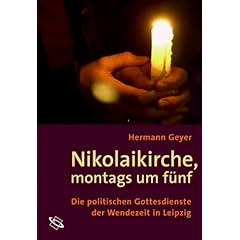 If there's one thing that Leipzig is known for in recent times it is the mass demonstrations in October 1989 where the city's citizens defied the threat of a massacre by government forces and went on the streets to call for change.
The weekly demonstrations had a regular rhythm - every Monday at 5pm, because they followed the weekly prayers for peace at Leipzig's Nikolaikirche - in early 1989 it was a couple of dozen people who went out on the street after the service to demand change, then it was a few hundred, then a few thousand - until a reputed 70000 people went onto the streets on 9 October, despite official warnings that reserve brigades were being called up, and doctors saying that the hospitals had been told to clear the wards and to make sure they were ready to deal with bullet wounds.
If there was however one reason why the church became the focal point for protest in Leipzig it was the weekly prayers for peace that began on 20 September 1982. They started at a time when Europe faced the deployment of nuclear missiles in West and in East and the growth of an independent peace movement in East Germany. They have been held on Mondays ever since. Today the prayers were led by Leipzig's Pax Christi, which developed out of a grassroots Catholic group that existed already before the peaceful revolution. Today they were remembering the Ecumenical Assembly of 1989, a gathering unique in the history of the GDR that brought together Protestants and Catholics, but also Orthodox, Methodists, Seventh-day Adventists, Quakers and others, and people from church hierarchies and grassroots groups and that made unprecedented demands for change in the German Democratic Republic - and about which more very soon.
Unlike 20 years ago, when the Nikolaikirche was so full that other churches had to be opened as an overflow, today there were "only" about 50 or 60 people at the prayers. Yet the unbroken weekly rhythm means that the people who were praying today are not only joined in prayer with those at the service itself but all those who have come before and who will come afterwards.
The book cover is from,"Nikolaikirche, montags um fünf. Die politischen Gottesdienste der Wendezeit in Leipzig" ("Mondays, 5 p.m. at the Nikolaikirche: Political worship in Leipzig during the changes") by Hermann Geyer, and published by WBG.
The Tiananmen Square "solution"
 Wroclaw, Poland: the memorial of 10th aniversary (1999) of Tian'anmen Sq. (Beijing, China) massacre, June 4th, 1989
The first version of this memorial was "erected" by Polish students a day after the massacre, June 5th 1989 - as a destroyed bicycle and a fragment of tank-track lying nearby.
The version in the photograph was erected ten years later, in 1999, and the symbolism is identical: bicycles against tanks...
I've spent some time this evening reading the Wikipedia article on the Tianenmen Square protests of 1989. It took me back to that Spring in Oxford when I was preparing my third year theology exams, worrying about how I was going to finance my year in East Germany if I got a visa, watching events in China and wondering whether events there would affect my travel to the Eastern Bloc.
I had forgotten how much what happened to the democratic protesters in China affected my mood as I set off for East Germany later in the year. As I read through parts of my diary I understand a little better the fear of violence and an authoritarian crack down that comes through in places. On the surface it may look as if life went on normally and peacefully but underneath there was real fear. The peaceful revolution might not have been so peaceful and earlier in 1989 the world had seen tanks vanquish peaceful protesters for democracy.
In late April 1989 there was still hope that things in China would develop peacefully. Remembering the brutal crushing of those protests makes me realise that those who went to pray in churches and lit candles in town squares in East Germany showed great civil courage.
To say nothing of the courage of the Polish students who in June 1989 set up the first version of the memorial depicted above.
Photo credits here
Posted by Rev J
26 April 2009
From Frankfurt to Leipzig
 Today I travelled from Frankfurt to Leipzig. In chronological, sequential time, it is a journey of about three-and-a-half hours, but in qualitative time, it represented a journey of two decades - backwards. Twenty years ago, I would have been going from one country to another, across one of the most highly militarised borders in the world, moving from one societal system to another, from the Federal Republic of Germany to the German Democratic Republic. Now I am making the same journey again, but in time, not in space. The border is no more, it's difficult even to work out where it once was - the train no longer stops for half an hour or more in a forsaken station apparently in the middle of nowhere, to allow the border guards to check the passengers and their wares. To make the trip twenty years ago would have required a personal invitation authorised by the GDR embassy or vouchers for one of the hotels open to western tourists - now all it requires is a train ticket. I'm going to that foreign country called the past in the year that marks the 20th anniversary of the "peaceful revolution" that led to communism being overthrown and the unification of Germany. The train journey is like a rolling reminder of German history. Eisenach, the birthplace of Bach, and Leipzig where he was the organist at the Thomaskirche; Weimar, home not only t
 o Bach, but also home to such other luminaries as Goethe, Schiller and Herder (but also the home of the Buchenwald concentration camp); and Naumburg, where Nietzsche died - but also Erfurt, where Martin Luther trained as an Augustinian monk, and the Wartburg, where he translated the Bible, but also Gotha, the location for the 1875 unity conference of German socialists whose programme was heavily criticised by Karl Marx. Luther the Reformer and Marx the Revolutionary. Yet in 1989, it was the followers of the Reformer Luther who led the (peaceful) revolution, and the followers of Marx who were overthrown. This blog is to remember the events of 1989 and how they are being remembered ... Posted by Dr B
Subscribe to:
Posts (Atom)


 Posts
Posts


