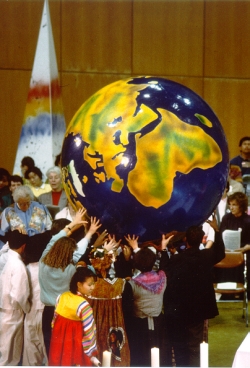
 Today - 5 March 2010 - marks the 20th anniversary of the opening of the World Convocation on Justice, Peace and the Integrity of Creation (JPIC) . Planned as the culmination of the JPIC process - better known in the then two German states as the "Conciliar Process" - delegates from all parts of the world converged for a week's deliberations in the South Korean capital of Seoul. It was intended to express "the urgent call for authoritative witness by the churches" in the face of injustice, hunger and poverty; war and violence; and destruction of the environment, stemming from an initative at the WCC's 1983 assembly in Vancouver, which, in large part due to efforts of the delegates from the German Democratic Republic, called on the WCC "to engage member churches in a conciliar process of mutual commitment to justice, peace and the integrity of creation".
Here, a key role had been played by the GDR theologian Heino Falcke, both in the run-up to the Vancouver assembly and in subsequent elaboration of the Conciliar Process in the GDR and at the global level.
In the GDR, the high point of this conciliar process was an Ecumenical Assembly of Churches and Christians which met in three sessions in 1988 and 1989, and which, not least because of the involvement of peace, environmental and human rights groups, made unprecedented demands for the reform of the GDR and influenced the citizens' movements and political parties formed at the time of the peaceful revolution of autumn 1989. According to Heino Falcke:
The ecumenical assembly raised the floodgates enough to release the log-jam of change. It gave an ecumenical inspiration to the dynamic for change, which also in a way gave it legitimacy; and above all, it gave it a direction that was set by the gospel.An ecumenical gathering was held in 1988 in the Federal Republic of Germany, and in May 1989, the first European Ecumenical Assembly, "Peace with Justice", took place in the Swiss city of Basel. By the time the Convocation met in Seoul, however, the world had experienced a change of momentous dimensions. The epochal shift can be seen not least in the chronology of the GDR itself. The Basel assembly took place just after the widespread rigging of already undemocratic municipal elections in the GDR that was one of the triggers for the "peaceful revolution" of autumn 1989. The world convocation the following year took place immediately before the elections of March 1990 in the GDR that led to the first freely-elected Volkskammer, the GDR parliament. Many of those - like Falcke - involved in the events that led to the "peaceful revolution" considered that they had taken part in a movement for liberation and a new more just, peaceful and sustainable world order.
Yet, for many of those in Seoul from the Global South, the events in Europe at the end of the 1980s were being regarded with suspicion. Certainly, in his address to the Seoul convocation, Frank Chikane, then general secretary of the South African Council of Churches - from a country where the release of Nelson Mandela and the unbanning of the African National Congress was also experiencing an epochal shift - described the changes in Europe as an opportunity to leave behind old models based on capitalism and communism and to replace them with new models "aimed at moving towards the Kingdom of God". However, he warned also that if the "First and Second World come together on the basis of the old system ... the remaining two-thirds of the world will be in trouble".
At the same time, the voices of Christians from the two German states (and especially the GDR), who had in many ways provided the motor for the conciliar process, were muted in Seoul. The specific conditions within the GDR which had given such force to the conciliar process disappeared with the autumn revolution. The conciliar process, whose origins lay in an initiative at a time of heightened East-West tension, was being overshadowed by the process of German unification. By the time the world convocation took place in Seoul, immediately before the GDR's free elections of March 1990, the collapse of state socialism in Eastern Europe and the accelerating process towards German unification had fundamentally shifted the terms of the debate.
In a recent paper, Falcke noted how East Germans themselves had little time after the opening of the Berlin wall on 9 November 1989 to reflect on the significance of the epoch-changing events. Instead, they were fully consumed by the "breathtaking processes" in their own country that led to the unification of Germany, 11 months later, in October 1990.
Falcke said that travelling to Seoul for the World Convocation had allowed him to gain a different perspective:
While I was there. I was often greeted with the joyful words, "The wall has been broken down!", but was made to feel very clear just how this process was seen from the perspective of other problems in the world and especially about the hopes and fears in Central America and Asia about the revolutions in Eastern Europe and the end of the Cold War.[The photo shows the closing worship at the Seoul convocation. Souce: http://www.wcc-coe.org/wcc/what/jpc/hist-e.html]


 Posts
Posts


