Redeeming the past in South Africa:In his book Christianity and Democracy, de Gruchy has written about the parallels (and differences) between the transition in the two countries.
The force of truth, forgiveness and hope in the search for justice and reconciliation
In September 1989 my wife and I spent a sabbatical semester at Union Theological Seminary in New York. For a few days we were host to the director of the Marxist-Leninist Institute in Rostock. He belonged to a group of theologians and philosophers from the German Democratic Republic, which was visiting the United States. It was highly ironic that in this way a Marxist professor from East Germany and a white, Christian theologian from the anti-communist, apartheid-ruled South Africa should meet in the United States of America! Nevertheless, we were bound together during this week in a way that neither of us would have been able to foresee. For this was the week of weighty, world-changing events, both in East Germany and in South Africa.
As we sat together, the East Germans and South Africans, we watched the events together on American television!Among the reports shown that week there were two that were boradcast immediately after one another. The first showed television footage of protest meetings in Leipzig and the of East German citizens fleeing over the border into Czechoslovakia, and the second was the escalation of the protest marches against apartheid in Cape Town, my hometown. Whatever the reaction may have been of our East German guest we knew that this meant the beginning of the end of apartheid. On top of that, we felt that the dramatic events in Eastern Europe were taking place in the same historical context as the events in our country. And that should come true. For without the collapse of the Berlin Wall in 1989, it was unlikely that change would have taken place in South Africa at that time.
For good reason, the reunification of Germany and the transition to democracy in South Africa have been characterised as two of the main events in the formation of world politics in the late 20the century. Some even claimed that these events were the prelude to a new world order. Even if we are somewhat sceptical of this claim today, these events have undoubtedly changed the course of history, no matter how we evaluate them. Events of weighty importance took place in Germany and in South Africa, radically transforming our lives and the lives of many others throughout the world.
Anyone who has watched television reports about the pro-democracy protests in Leipzig or Cape Town, would have seen the presence of priests, pastors and even bishops - at least in Cape Town! - among the leaders. There were many others among the crowds that were there from Christian conviction and commitment. Yes, Christians, and some church leaders and groups have played a key role in those important events of the transition, just as they had been committed as the precursors of these changes.But we should be reminded that the contribution of the churches to the struggle against apartheid was far from clear, it was hesitant and ambiguous. Some churches even provided the theological justification of apartheid. Even those churches that were against apartheid, have hands that are unclean.
The churches have much to confess about guilt and failure. In the majority of cases, the Christian opposition to apartheid was left to prophetic loners, charismatic leaders, ecumenical bodies and quasi-religious organizations. Too often the churches hid behind such brave testimonies, prophetic, instead of getting involved prophetically in the struggle for justice and liberation.(Provisional translation from the German)
Showing posts with label South Africa. Show all posts
Showing posts with label South Africa. Show all posts
11 November 2009
From East Germany to South Africa
It was not only in East Germany that weighty events were taking place in the latter months of 1989. In South Africa, too, the End Game had begun. In September 1989, the South African theologian John de Gruchy had been in New York where - together with a Marxist professor from the GDR - he watched the growing popular protests in the GDR and in his home county, an experience he described in 1997 at the Leipzig Kirchentag:


6 May 2009
Negotiated Revolutions
 Sitting in the cafeteria of the Ecumenical Centre in Geneva yesterday I was discussing the parallels between South Africa and East Germany, and mentioned that the other symbolic transition to democracy taking place was in Chile, where in December 1989 an election marked the end not only of the Pinochet area but can also be seen drawing a line under the era of military dictatorships in Latin America that ruled from the mid-1960s to the 1980s. George Lawson in his book, "Negotiated Revolutions", has focussed on the parallels - and differences between South Africa, Chile and, if not the GDR then the Czech Republic. His conclusion is that:
Over upcoming years, we will see whether negotiated revolutions traverse the recalitrant line between idealism and realism, avoiding the perils of an overly optimistic, naive altruism on the one hand, and the crudeness of a raw struglle for power on the other. That is both the ultimate question and the fundamental challenge to come.Still, I wonder whether "negotiated revolution" is an adequate category for describing the East German (or Czech) experience. True, there was a Round Table bringing together both the "old" and the "new" forces - but was it a revolution that was negotiated, or a revolution tha
 t led to negotiations? And if so, what sort of negotiations? Georgina Waylen, in "Engendering Transitions" has focussed on the role of women's organizing in the breakdown of non-democratic regimes - again she makes comparisons between South Africa, East Germany and Chile. Using empirical material drawn from eight case study countries in East Central Europe and Latin America as well as South Africa, she explores the gendered constraints and opportunities provided by processes of democratisation and economic restructuring. Her conclusion is:
To be most effective the newly important political arena and the transition itself has to be relatively accessible to women actors. From our case studies it appers that pacted and relatively drawn out transitions with negitiation processes are more likely to be accessible to women actors. Powerful participants in those negotaitions, particularly within the opposition, have to be open to gender concerns and feminists have to be already present or have access to those arenas.
4 May 2009
Endgame
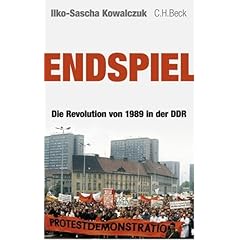 Endgame (Endspiel) by Ilko-Sascha Kowalczuk is the title of one of the many books released this year to mark the 20th anniversary of the GDR's peaceful revolution and the fall of the Berlin Wall. Kowalczuk, a researcher at the office of the Federal Commissioner for the archives of the former GDR state security service, traces the events in the GDR from mid-1988 to the first free elections in the GDR in March 1990. Endgame is also the title of a feature-length drama
  shown on Channel 4 this evening about a series of secret meetings (taking place at the time the GDR was imploding) organized by Michael Young, then director of communications for Consolidated Goldfield, that helped pave the way for the end of apartheid in South Africa. This juxtaposition is a reminder of how the changes in Germany at the end of the 1980s need to be seen against the background of a wider epochal change. My own memory of how these two movements are interlinked is that on the day of the Nelson Mandela 70th Birthday Tribute Concert, held in Wembley Stadium on 11 June 1988, I was at a meeting of the German-German working group of European Nuclear Disarmament, where we had one eye on the TV and another on our discussions. The mood in the GDR was sombre - a crackdown on dissent had led to activists being involuntarily exiled from East Germany, there were growing protests against state censorship. Less than 18 months later the South African theologian John de Gruchy was in New York where he watched the growing popular protests in the GDR in September 1989, an experience he described in 1997 at the Leipzig Kirchentag:
Unter den Meldungen der Woche gab es damals zwei, die unmittelbar nacheinander gesendet wurden. Die erste zeigte Fernsehfilme der Protestversammlungen in Leipzig und die Flucht ostdeutscher Bürger über die Grenze in die Tschechoslowakei; die zweite zeigte die Eskalation der Protestmärsche gegen Apartheid in Kapstadt, meiner Heimatstadt ... [Wir] wußten..., daß dies für die Apartheid der Anfang vom Ende bedeutete. Darüber hinaus spürten wir, daß die dramatischen Ereignisse in Osteuropa in einem geschichtlichen Zusammenhang mit den Geschehnissen in unserem Land standen. Und das sollte sich bewahrheiten. Denn ohne den Zusammenbruch der Mauer in Berlin im Jahr 1989 wäre es unwahrscheinlich, daß die Wende in Südafrika zu dem damaligen Zeitpunkt stattgefunden hätte.In his book Christianity and Democracy he has reflected on the parallels (and differences) between the transition in the two countries.
Subscribe to:
Posts (Atom)


 Posts
Posts


