Showing posts with label Diary of a revolution. Show all posts

18 March 2010

Election 1990 - Strangers in a foreign country

Today (18 march) marks the 20th anniversary of the first free elections in East Germany, less than six months after the mass demonstrations that undermined the communist state, and less than five months after the opening of the Berlin Wall. It was a curious mixture of old and new (the picture shows one of the ballot papers used in the election). The alliance of newly-founded citizens' movements and parties that had originally pledged to fight free elections on a common platform has fractured under the pressure of events: the Social Democratic Party of the GDR (founded by opposition activists) has joined forces with its opposite number in the Federal Republic. Helmut Kohl's (West German) Christian Democratic Union, looking for a partner of its own, has signed up with the East German CDU, for four decades a satellite of the communist SED. with revolutionary legitimacy provided through an "Alliance for Germany" with the Demokratischer Aufbruch, and the small German Social Union. Neues Forum, once the rallying cry of the peaceful revolution has become part of the Bundnis 90 grouping, along with Demokratie jetzt, and the Initiative for Peace and Human Rights. The election has become a battle between the proponents of a rapid and a less-rapid union with the Federal Republic.

It is election day, and Jane is preaching in Greppin, the small parish hall is packed on this Sunday:
Dear Sisters and Brothers in Greppin

As I prepared for my year in the GDR I never thought that I would experience free and open elections here. Maybe I should say that I grew up with politics, my father has been for many years either the mayor or the opposition leader in our town. When the elections took place, the children of course wanted to help, it was just something we took for granted. I can still remember that last year I thought that this at least was something I would not be doing in the GDR. But now there are free elections, a wonderful thing to be happening. Yet in many of the discussions I have had, I have noticed that the closer that election day comes, the greater the uncertainty about "what comes after". It's difficult to live with uncertainty, but it was also much more difficult when we knew exactly what would happen next. Our text today (Hebrews 11:8-10) is about Abraham and how he was ready to live with uncertainty:

8 By faith Abraham, when called to go to a place he would later receive as his inheritance, obeyed and went, even though he did not know where he was going. 9 By faith he made his home in the promised land like a stranger in a foreign country; he lived in tents, as did Isaac and Jacob, who were heirs with him of the same promise. 10 For he was looking forward to the city with foundations, whose architect and builder is God.

... I don't know about you, but I would not like to spend my life in a tent. Living in tents is a dangerous business. But how can we learn to live in tents in this time of anxiety before the election. How do we learn to live with uncertainty. There's no easy answer, no promise that things will get better. But one thing is sure, God does not want us to build walls to cut ourselves off. A tent is sensitive to wind and to rain. We must be sensitive, sensitive to other people, talk about our fears.
After the service, Stephen and I go for a walk in the nearby countryside, the Dübner Heide. The GDR seems to have got used to this election, everywhere there are posters put up, torn down, posted over other posters. Then we drive to Leipzig to watch the election results with friends. the results come in. General astonishment when the results are declared: the CDU (which a year earlier had been part of the so-called "Democratic Bloc" with the SED) gets more than 40 percent, the SPD just over half that. 16 per cent for the Party of Democratic Socialism, which used to be the SED. Just 2.9 percent for the civic rights activists in Bündnis 90. Before the election, many commentators had treated an SPD victory as a foregone conclusion. I'm disappointed too, but I hadn't expected it to be different.

17 March 2010

Selling Stasi documents in East Berlin

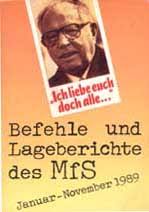
17 March 1990 - Tomorrow is election day in the GDR. Today, Stephen arrived back in Berlin from Seoul where he had been working at the World Convocation on Justice, Peace and the Integrity of Creation. I go to meet him at the airport. Hiring a car (and getting his first ever GDR parking ticket for stopping to ask where he could park), we stopped off at the Gendarmenmarkt in East Berlin. Here the synods of the previously-divided Berlin-Brandenburg Protestant church were having their first joint session. Less than 100 metres away from the Französische Friedrichstadtkirche where the synod is taking place there is a queue outside an unprepossessing building, now called the House of Democracy, and home to the various civic and human rights groups. They are selling a printed volume of Stasi documents, showing how the state security ministry has systematically tried to undermine and subvert opposition activity in the GDR (second hand copies are still available on Amazon). People around the church where the synods are meeting are flicking through the slim volume - some of them to see whether they were the targets of the Stasi. Later on we head back down to Greppin, in the middle of the Bitterfeld chemical works. I'm preaching tomorrow - election day.

11 March 2010

Living next to the chemical works at Bitterfeld ....

From Jane's diary: 11 March 1990, 2am

It's two o'clock in the morning. I am supposed to preach in the morning, and I can't sleep.

The time at Wittenberg came to an end in February. Stephen finally managed to be given a visa and has visited a couple of times. The prayers for renewal are continuing but with far fewer people as in the autumn. The atmosphere is very different now. The election campaign has started, posters are being put up everywhere, even in the shops. I make a speech on behalf of the SPD, the social democrats. It was quite fun, though I have to say even I am not quite convinced that they would get my vote in this situation.

One by one the other students left Wittenberg and went back to their parishes and congregations. It was strange to say goodbye and to know that this part of my life here had come to an end.

I am doing an internship with Axel and Gisela Noack in Wolfen (known for its photographic film factory ORWO, for Original Wolfen. It used to be Agfa until the Second World War). I've moved into the empty manse in Greppin, a small industrial village half way between Wolfen and Bitterfeld. On three sides the village is surrounded by the Bitterfeld Chemical Works. The people of Wolfen and Bitterfeld argue as to who has the most polluted town, but the people of Greppin don't have to argue, they just know that it very rarely doesn't stink here.

From my window I can look over the cemetery to a wonderful view of the factory chimneys. The one that's closest to us has a permanent plume of smoke. It's 2 o'clock in the morning, and I have to hold my first sermon in the morning, and I can't sleep. The air is terrible. The factory seems to pump out even more filth at night than during the days. The noise just carries on. Sometimes in the middle of the night I am a sit up, bolt awake, when the sirens go. I can't get the nightmare out of my mind - what would happen if the chemical works went up in smoke?

(The picture shows the manse in Greppin, from April 2009. The chemical works have gone now. More pictures from this disappeared past can be found here.)

10 January 2010

Now off to Poland ...

Jane's diary, 10 January 1990, Wroclaw, Poland
We Wittenberg students have travalled to Poland. Stephan Bickhardt organized the trip. It's his last week with the group, he will soon start work as the general secretary of Demokratie Jetzt (Democracy Now). It's my first visit to Poland, my grandmother was born in this city, when it was still the German city of Breslau. We are being hosted by the Catholic Intelligentsia Club (KIK). We have speant a lot of time talking with them and Solidarnosc about economic issues, but also increasing xenophobia between Germans and Poles. Our discussions have sometimes been very painful, and I realise just how I am affected when there are antisemitic remarks about Jews. But we have also experienced a wonderful and warm welcome. Today we went to Kreisau/Krzyżowa, known for the Kreisau Circle, the name the Gestapo gave to a group of dissidents around Helmuth Graf von Moltke who gathered in his estate at Kreisau. The KIK in Wroclaw is supporting attempts to make the estate a place for intercultural and international exchange and dialogue. As we are going there, I noticed just how poor the people on the land seem to be. The countryside and the mountains are wonderful but where we walked the little stream was a strange dark blue coulour and it smelled of chemicals. Yes, said the priest, today the nearby factory is dying jeans. We also met a wonderful Catholic priest who had a picture of Pope John XXIII in his office. Why John XXIII and not Pope John Paul II, we asked. He said, the church belongs to JohnPaul, but in his office he can chose the pope he wants!

17 December 2009

Coming home ...

Jane's diary, 17 December 1989, dateline Brussels
The train was late leaving Cologne and arriving in Brussels, but Steve was there, we went back to his flat in St Josse, drank Champagne and went to bed. In the morning we woke up to hear that Andrei Sakharov had died, suddenly. Amazingly, things seem to be starting in Romania but what will happen ... unbelievable to think that a change might take place there too.

In the evening we went to the Brussels Labour Party Christmas Party, very yummy food, and "terribly" nice and civilised. Full of journalists. It was strange to step back into middle-class British (Euro) culture. Steve in his Guardian sweatshirt was not dressed for the occasion, but it was fun. Then I gave him my diary to read and we stayed up talking about all that had happened in the GDR over the last three months while I was there.

And finally the next day ... he baked me pizza, as I knew he would, it was good and very much a coming home feel. We sat and chatted to his landlord, Jean Pierre and his partner Brigitte. It was hard to speak French, very hard work for me. After three months caught up in a whirl of change, it is strange to think that being here in Brussels is a reality as well.

14 December 2009

Helplessness and resignation?

Jane's diary, 14 December 1989, written in the train from Cologne to Brussels

What a crazy few days, writing Christmas post, washing, buying, packing ... 10 December was international human rights day, Friedrich Schorlemmer received the Ossietzky prize on behalf of Demokratischer Aufbruch. In Czechoslovakia, the Communist Party is now in a minority in the new government, Husak's final act as president was to swear in the new ministers, some who have been in jail until as little as a fortnight ago. Change seems even faster there than here in the GDR. Dubcek or Havel for president? All the shops were open in Wittenberg this afternoon, a Sunday, the 2nd advent, a cold clear day with yellow winter sunshine and a Father Christmas being driven in a horse and trap along the main street throwing out sweets to children.

I was full of cold for my last few days in Wittenberg. On the Sunday I made it to church. The church was cold and the sermon somehow missed the mark but the BBC Radio 4 service was coming from the United States and I was back in time to hear Barbara Harris finishing her sermon and then celebrating the Eucharist, the first woman to be elected a bishop in the US Epsicopal Church. That was special.

I got an exit visa in Wittenberg but when I got to the border in Berlin the border guards couldn't tell me whether or not my new entry visa was there. I crossed into the West with two of the other students who like me were in Berlin for a meeting with students from our sister seminary from West Germany, Soest. The other two went off to get their church Begrüssungsgeld from West Berlin (hard currencyto which otherwise East Germans had no legal access). The people there wanted to give me some too - quite seriously. Very odd!!! Then we set off on the 54 Bus for Spandau, which I knew very well from the gap year that I had spent working in a church-run children's home at the Johannesstift there. It was strange seeing the Christmas market in Spandau gain, just as it had been eight years ago, and the kitsch almost worse then the stuff in Wittenberg. Then out to an evening with the Soest lot at a Pizzeria at Savignyplatz in West Berlin where red wine was consumed. I stayed over in West Berlin.

The next morning back to the border, where, amazingly a visa was waiting for me - and free of charge!! But the Polish visa office in East Berlin was closed - I needed to a get Polish visa for a trip our group was to make to Poland in the New Year. Then to the church headquarters in Augustrasse still a little worse for wear from the night before. I managed to make it back to the Soest meeting at the Auferstehungsgemeinde. I found myself in one group suddenly feeling like an easterner in a strange sort of way, chafing against the wishy-washy western liberalism. The crux of the question is not whether the we feel the "experiment" of socialism in the GDR should go on, but what are we willing to give up, we privileged Westerners and the answer is, "not a lot".

Earlier in the day at the foreigner's registration office at the police in East Berlin, I interpreted for a very sweet but rather clueless Australian who kept trying to pay in the wrong currency. This then led the overworked woman behind the counter to extend my residence permit until June 1989 - in my hungover state I didn't notice, but later in the evening the border guards didn't seem to mind too much, "just make sure that you get round to registering properly"!

Berlin was so wet and disgusting that I simply wanted out and away. On the train I thought back again to the German question, our sense of helplessness and resignation, no new ideas in the face of its inevitability and the lure of the Deutschmark. Whatever happened to "We're staying here!" On the train the guard noticed my ticket had been bought in GDR Marks in East Berlin and didn't ask me to pay the supplement for the InterCity train, it's strange being a token GDR citizen.

3 December 2009

Things keep moving on ...

Jane's diary, Wittenberg, 3 December 1989
Last night we "celebrated" Advent. Suddenly Christmas is around the corner. The candlelit living room and appalling singing, and then a reading of Schleiermacher's Weihnachtsgeschichte. All rather German.
Meanwhile things are moving on apapce. Mittag, Tisch and Müller (from Erfurt) have all been arrested. The central committee and the Politbüro have both resigned - Krenz is still Staatschef but everyone is waiting for him to be toppled, arrested or something. Let's hope Hans Modrow can continue to walk home each night and carry some kind of trust with him. Honecker, Tisch, Mielke et al have all been expelled from the SED. Meanwhile Schalck-Golodkowski has disappeaed to another country (unknown) and let this be known via his lawyer Wolfgang Vogel.
All kinds of shady and immoral deals are coming to light - an arms cache has been found near Rostock, deals with South America and no doubt all kinds of currency scandals. It's incredible. In Czechoslovakia the Kampfgruppen - the worker's "defence" units - have been dissolved.

2 December 2009

December is Advent ...

Jane's diary, Wittenberg, 2 December 1989
What an amazing first day of Advent. The GDR sent official apologies to Czechoslovakia for the part it played in the 1968 invasion. The Volkskammer got rid of the article 1 of the constitution - no more "leading role" for the SED. Gorbachev went to the Vatican and had an audience with the Pope; and Wolf Biermann played his first concert in 13 years in the GDR- amazing!! He was utterly magice, had us in creases of laughter and then near to tears with his lyrics and talk.

29 November 2009

The quiet before the storm ?

Jane's diary, Wittenberg, 29 November 1989
It is cold. Last night, the church was full for the prayers for renewal but not as full as we have become used to. Afterwards they went "on a walk" to the local headquarters of the Stasi, now renamed National Security or something. This morning Frau. B talked of ministers clearing their desks and whether they come across decisions they would rather un-take. Perhaps this pre-Christmas calm is just the stillness before the next round of wild events. Meanwhile things move on apace in Czechoslovakia - a petition is being planned here if the GDR government does send official apologies to the Czechs and the Slovaks for the happenings of 1968 ...

Meanwhile, of course the theory that there are only 25 people in the world rools on. Daniel Cattau, for whom I was interpreting a few days ago, and Stephen worked together on the press desk at the Lutheran World Federation assembly in Budapest in 1984.

26 November 2009

Thinking about those who have gone before

Jane's diary, dateline 26 November 1989, Wittenberg (Totensonntag)
Today is Totensonntag, the Sunday to commemorate those who have died. Outside is is snowing, blowing up quite a blizzard. Strange to think that at the beginning of the month I was still walking around bare-legged. Mild autumn has changed to a bitter winter as quickly as the political changes.

Wittenberg looks pretty in the snow, even more mediaeval than it is. At the last demonstration at the Marktplatz it was so foggy you couldn't see from side to the other, Luther's and Melanchthon's statutes were lit up and the loudspeakers were on as usual - it seemed as though the statues themselves were speaking. With all the fog, the icy weather and the voices seemingly speaking out of nowhere, Birgit said she falt as though she was living through a Shakespeare play. They discussed making Friedrich Schorlemmer an honourary citizen of the town.

Apparently on the television the other night (the first live talk show broadcast on GDR television!) Schorlemmer said, "I have been turned from an enemy of the state to a partner". It was interesting to interpret for his interview with Daniel Cattau today, I'm not sure about the picture he likes to paint of himself - certainly he is very literary and well-read and heavily influenced by Tillich, Brecht and so on, but it all seems so very slightly pretentious. One of seven children who needs a crowd! I feel he painted a rather rosy picture of the role of the church in the future and how it will be able to continue its prophetic role.

It's been a time of coincidences for me - first bumping into Keith Forecast last week who had been at Mansfield just the previous evening. And then turning round in the restaurant in West Berlin and seeing our family friends, Theo and Sigrid. Yesterday Daniel arrived in Wittenberg, writing for a US Lutheran paper, a few years ago he interviewed Jan Womer at Mansfield.

I've got used to the idea I was in West Berlin last weekend. But that clear sunshine and fast pace of life seems a time away from the muffled snowy streets of Wittenberg today. I thought about Steve, I wanted to sort out the existential questions to do with getting married and living together, he was preoccupied with the great political happenings. Of course we sat down and tried to sort it all out but there was so little time and so much to say. I have this need for certinty and Steve is so much more sanguine. In just over a fortnight I shall be packing to go home for Christmas. Time is really racing by.

Briefly today I thought of my dead ancestors - rumbustious Stanley Hawley, impeccably turned out, a man who in middle age (he never really seemed "old" to me) showed great patience and love to his two grandchildren. He died carefully and tidily, all his affairs sorted out, his house clean and tidy, during one week's holiday three years ago. I miss him dearly, his love of life, his palpable enjoyment of parties and celebrations, his ability to get on with different generations. It was right that his funeral was a party in the garden on a late summer day.

He and my grandmother Elsie Bennett played a big role in babysitting us and being around in our lives. They had already made a mark on the town we lived in through their involvement in music and shows. My grandmother's wide and very pretty simile, her competitive spirit playing cribbage - even beating my dad at scrabble - but most of all her beautiful soprano voice, rich soaring and so easy on the ears - "the gentle, the gentle sounding lute". I was 16 when she died, the early morning 'phone call came and I felt relief for her and for us all, as well as loss. It had taken a long time.

Martin Stranz my German grandfather was born in 1890, a completely different world. His death shocked me, and shook me early on Saturday morning. I wept in my father's arms and felt gult, "but I had only just begun to love him". He represents all that is intellectual but also a love of the good things in life - his brother-in-law in his will left him red wine to pour into his soup! Part of the money I have used to come here came from the money he gave us, his proud socialism and pacifism came from real experience. I wish I had been able to hold an adult conversation with him. Perhaps my interest in Germany comes as a result of dealing with his death. He was 85 when he died and had lived through two world wars. Despite his age, all of us where unprepared for his death, suddenly on holiday in Cromer after a good meal with friends, Probably he insisted on paying the bill. He only allowed us to celebrate his 85th birthday if he could pay.

Kate Guttmann his wife I only knew from a picture where I am sitting on her bed, she lived to see her first grandchild. She was very unkindly referred to as the Schlange - the snake - or the Hexe - the witch - by her children. From my other grandmother's one meeting with her it sounds as if she was the quiet one in a family of extroverts. The weeks that my grandfather was in Sachsenhausen concentration camp must have been difficult for her. She worried about illegally smuggling her wedding ring out of Germany when they left. Probably she found the move to Britain more difficult that the others. A sensitive, artistic woman. Perhaps we may call a daughter Kate.

I think of you as I write this Stave. Tears are streaming down my face as I do my Trauerarbeit, my mourning, as the Germans like to call it. Death has treated me more kindly than you and not taking my family away from me unexpectedly. I shall stop now and sort out my ever untidy desk - it seems to travel from country to country with me.

25 November 2009

What's happening in Czechoslovakia and Romania ..?

Jane's diary
Dateline: Saturday 25 November 1989
Time is racing past. Our ten days module at the Predigerseminar is over. It began with everyone piling into our room and swapping stories of crossing the border or wall. The best story was the friend of one of the students who came out of the Berliner Ensemble bar fairly drunk and heard that the borders were open and decided to go to the Wall to argue with people and get them to go back, only to find himself swept along with everyone else and so completely gobsmacked that he spent most of the weekend pi**ed. For Berliners the open border adds a dimension which should always have been there but wasn't. As Karsten says, every says "here" but no one seems to know where "here" is. East or West? or East and West.
For our friends in West Berlin where he is a West German and she an East German the whole thing has been completely exhausting as well as totally exhilarating. Their flat was full of visitors from the East, all of us piled in for that first night - completely crazy.

Meanwhile events in Czechoslovakia have looked very ominous over the past 10 days but last night the central committee resigned en bloc and today half a million demonstrators in Prague. Dubcek spoke and was introduced as the county's future president - 20 years too late. Vaclav Havel will speak on television tonight, uncensored. It's all utterly amazing and wonderful, so sad and tragic that state brutality preceeded it to such an extent. Dissidents are being released and a coalition government proposed.

Back here Krenz is saying that free elections are not likely until the end of next year. I think it would be crazy to have parliamentary elections next May, much better to re-run the local elections of this year so that at least the new groups get experience at the municipal level.

Events in Romania seem still to be well behind those elesewhere in the Eastern bloc. It's awful to think of the culture that has been wiped out and this will continue if change doesn't come. All we can do is pray and hope the change will spread there too in this November of revolution and "Wende". Back here one of the students discovered swastikas on his wall in Görlitz and now that the press is "free" more and more reports of Poles being stopped at the border smuggling food. There's a real hatred of Russians and Poles developing here. We discussed this as we prepare to go to Poland in January. In a fortnight at a meeting with our counterparts from West Germany we will talk about Neo-Nazi tendencies in young people.

20 November 2009

Over the Wall and back again

Jane's diary: Wittenberg, 20.11.1989
What a weekend! I was so tense on Thursday, the train to Berlin was late and I had to work hard to keep calm. Then to the foreigners' registration office at Alexanderplatz in East Berlin. Finally after a bit of to-do the man at the office gave me an exit and re-entry visa meaning I could go to West Berlin and come back to the GDR. I tried to phone West Berlin and it just wouldn't work. All lines engaged. It's been like that for days I reckon.

Walking along Friedrichstrasse towards Checkpoint Charlie I bumped into Christa Gengel (ecumenical officer of the Evangelical Church of the Union) and Keith Forecast (moderator of the United Reformed Church general assembly). Quite a ridiculous coincidence, the previous evening he had been preaching in Mansfield Chapel (in Oxford where I did my theology studies) and they had said, 'Of course you won't see Jane but if you do, tell her we miss her and give her our love'. Suddenly I felt a pang of homesickness for them all, miles away from German Sachlichkeit.

It was interesting to speak about the current situation with Christa Grengel. The woman who works with Christa looks well and relaxed, opening the borders really has opened people up. But Christa Grengel seems rather pessimistic about the way ahead - things are going too quickly, the church had proposed the gradual opening of the border and not the current free for all.

Were there any native Berliners in East Berlin at all? Everyone I tried to ask the way was Polish or Russian or from outside Berlin. Very odd.

Finally, after my interrupted evening I crossed at Friedrichstrasse, much quieter than earlier. So strange, the whole atmosphere was so different, much more friendly. It was so incredible to be on the S Bahn to Bahnhof Zoo in West Berlin. Then on to our friend Horst's where Stephen had arrived as well as other visitors from the GDR.

West Berlin was like I have never known it - but then it's never been like this. What an incredible atmosphere. All along the Wall people have their hammers and chisels and are making holes in it, taking chunks away to sell to the Americans - now the West Berlin police are doing their best to protect the wall. At Potsdamer Platz - what used to be the heart of an undivided Berlin, a new crossing point has been made, the Wall simply torn down. Nearby British solidiers are doling out free tea and coffee (a very British form of deterrence), with the East German border guards looking on.

A truly amazing weekend but at the end I had to walk back into East Berlin through Checkpoint Charlie by myself. Stephen came with me to the border and went through first but the border guards still wouldn't let him into the GDR. He came back out and said they had been much more friendly than the last time he had been refused entry but their records still said that he was "unwanted" in East Germany. So through the dark streets of East Berlin with tears on my cheeks to take the train back to Wittenberg.


16 November 2009

Trying to find a way into the future

Jane's diary: Wittenberg, 16 November 1989

I'm completely wound up. I am waiting to travel to Berlin. I'm waiting for a phone call at midday from Steve. For two days I've been like this, moods swinging back and forth. I've had to completely reorganize everything to get to Berlin. I was at the police station this morning. I can get out of the GDR, but, unlike the East Germans, I can't get back in again, because I only have a single-entry visa. Steve: what are we going to do if we can't meet? I really think I shall crack. It's three months since we got engaged. Dear God, I hope this madcap plan works out ...

So much has happened but I feel in such a whirl - totally emotionalised. I want to laugh and cry and scream. The atmosphere is changing a bit. I'm not quite sure if all these groups are going to keep up the momentum, now the wall is down, at least psychologically. The prayers for renewal on Tuesday were still full at both churches - suddenly now that the crisis point is for the time being over, people are are suddenly able to pray, not just for themselves as has been the case in past weeks.

Suddenly we remembered that Romania exists. We lit a candle for the person facing the death penalty there. We sent a telegram to the Embassy. People prayed for the schools, for the environment, for not too much greed for western money. One of the students had found swastikas sprayed on the walls in Görlitz - we prayed for the fascists. The emotion was really very different at the service, not so tense or brittle. In some ways that was a shame, the tears didn't prickle behind my eyes, my voice didn't break with emotion. Perhaps a certain amount of normalisation would be good. A time to reassess, think hard, give thanks for all that has happened and try and see a way into the future.

The Bürgermeister has resigned, at the demonstration later in the square they gave his deputy a hard time. The new Bürgermeister will be elected today. As a result of standing up for so long in very cold churches and then sitting in a Trabant for over an hour my back is in all sorts of mess. Very painful. I drank a glass of wine with two of the women in Wittenberg. We listened to Mahler's 4th symphony and tried to sort out our feelings and worries about the incredible almost miraculous events of the weekend. When will the price reform come? Feelings are very ambivalent. Everyone wants to be able to exchange GDR money for western money but will it still be possible to afford bread at home? Things are going to get worse before they get better, that's for sure. Oh dear, that sounds so Thatcherite and smug.

12 November 2009

Retribution or accountability?

Jane's diary, dateline 12 November 1989:

Three SED district officials committed suicide yesterday. I worry about Schadenfreude. Hunting down the guilty ones as if none of the rest of us are guilty - have the CDU, LDPD, NDPD (the block parties linked to the SED) done nothing over these years. Are they going to get away without having to confess? I wonder how many people would not have been involved in corruption in some form or another.

Two of the new central committee members have already had to resign - Cottbus and Halle in SED districts voted them out of office at their respective local levels and they've had to go. The reasons aren't all that clear but Boehme (district SED secretary in Halle) may have been voted out because of the appalling violence in Halle on 9 October. It still isn't out in the open whether he or the Stasi chief gave the order "to clear the centre" ( very euphemistic expression). People are now saying the Stasi should be sent to the factories. All that listening in to, watching and frightening people doesn't bear thinking about.

Yesterday I was in Jüterbog to interpret for two Americans from the United Church of Christ. Jüterbog is small has four very enormous and very beautiful old churches, one now converted into a library. It was an old Handelstadt and has similar architecture to my beloved Hansastädte. This area of Brandenburg is called Fläming - rolling countryside and woods. The name and the architecture indicating the Dutch connection. I'm extremely cross I have allowed myself to be talked into this although it has been interesting in all kinds of ways ...

More amazing pictures from Berlin. The West Berlin police and the East German Grenztruppen working together. More jubilation and of course all the litter and rubbish, bottles, paper plates.

In Jütterbog as all overt the GDR the State Bank and the police were open all day on Saturday and Sunday to cope with the queues of people. The Reichsbahn has laid on extra trains, in Leipzig they ran out of tickets for people travelling to Berlin. Each year GDR people can change 5 Marks at 1 to 1 for 15 DM. This is nothing. Can the government really afford to make the currency convertible, rampant inflation is sure to follow. The new economic proposals seem to suggest some kind of price reform. When? How quickly the next change.

On AK2 (the East German television news) the strange sight of the head of the police advising people to leave their cars on the edge of Berlin and to try to avoid the overcrowded crossing points. "Unless you have to go over now, then don't. Please believe me this new law will last so try to be patient". Wierd! Then an interview - a real interview - with Krenz about reunification. Basically he said this is Herr Kohl's problem and not mine, The GDR constitution is very clear on this issue. Whether Kohl should consider sorting out the Basic law is another matter and on which I cannot decide and which is not a GDR matter.

Interpreting for the Americans again this morning in small village churches. Thankfully a fairly straightforward sermon in easy language - I was surprised at how easily it all went. I was very thankful for the French onion soup at lunchtime, I got very cold in the first church where we preached. Winter has finally arrived, frost this morning and a real November mist, damp cold getting through to your bones. Somehow it had seemed as though the summer would last for ever but maybe the greenhouse effect isn't bad enough yet for that.

My feminist anger is dying down a bit now but if I get called "Fräulein" once again I might just boil over.

10 November 2009

'What lies ahead of us?'

Jane's diary: 10 November 1989 later in the day

Today the SED declared itself in favour of an electoral law with free and fair elections and secret ballots. How many more rabbits can be pulled out of the hat this week. Perhaps Krenz has won himself a little breathing space with these measures over the past two days. It looks as if the whole episode yesterday wasn't intended as freedom of movement - the new travel law was supposed to come into force on 1 December in time for Christmas. Schabowski actually said those wanting to leave the GDR could do so via the GDR border instead of via Czechoslovakia. But the people took the ruling into their own hands and basically flooded the wall. Utterly sensational.

For each day people spend in the west (currently 30) they are allowed to change 1 GDR Mark into 1 DM but otherwise the GDR currency is not convertible. That alone may persuade people to leave. Who knows. Racketeering is likely to grow particularly if there is a price reform. Who knows? Earlier in the week I felt instinctively that a price reform must come but surely not until after Christmas. Political suicide to do it before things are moving so fast who knows what will happen next.

Of course all this has caught the West utterly on the hop (the Russians too, I reckon). It was interesting that as the interviews progressed during the day people tried to be more sanguine and reflective. Not succeeding a lot mind you. There is appalling ignorance in Britain of the GDR political system and structure summed up by Sue McGregor's question (a British radio journalist) to Pfr. Seidel in Leipzig this morning, "Has your party - the LDPD - been legalised yet?". reply - "Yes since 1947". Similarly the woman on the "Any Questions" radio programme pronouncing, "East Germany doesn't have an opposition party". Still she is only a high ranking civil servant.

The assumption in all the reunification debate is that the problem is East Germany becoming part of NATO. The problem is of course the thousands of Soviet troops in the GDR (of course there are the western troops in the Federal Republic). Then to cap it all Manfred Woerner of NATO says of course NATO's existence isn't threatened by these changes. It has contributed to the stability and without it this change wouldn't have taken place. What nonsense!

10 November 1989, 23:30

The central committee has in fact today announced economic reform - more consumer goods, gradual removal of subsidies. But the financial news tonight is spreading doom and gloom - hyperinflation and problems of quality and motivation of workers looks more and more likely - quite apart from crisis in public health and transport. Is it all going to go BONG?? Dear God, what lies ahead of us ...???

I went to talk to Friedrich (Schorlemmer) when I knew the BBC were going to interview me. He's ill and looked pretty ropey. Bloody RIAS phoned him at 5am this morning 'unangemeldet' - without notice. We spoke of the whole guilt question. Suddenly everyone's pointing the finger at SED leaders as if no one else contributed to all the problems here, as if most of the population hadn't gone to the polls and voted for the SED lists last May.

And the role of the church now? Balance? Keeping the peace? Besonnenheit - trying to get people to stay calm? Friedrich spoke of the need for Klage and Anklage- I'm not quite sure I understand this - lamentation in Biblical terms from the depths of our hearts - like in Psalms? Also accusation coupled with Besonnenheit.

Also he's very concerned that the church should confront the whole Zweistaatlichkeit question (the issue of there being two German states). What Germany? Very important for the church to give a lead. However I reckon there are lots of different tendencies within the church and that there are going to be all sorts of people coming out of the woodwork. We'll see.

Kohl say Germany is now free - our free German fatherland - I find talk like this very disturbing.

Let's wait and see: the central committee proposes electoral reform, a new media law, freedom of assembly, and bringing the state under parliamentary control.

If the wall really goes maybe reunification will be the only way that this country will survive. My heart is with all this historical day stuff. What really lies ahead? Will we still be able to afford food in February? Now Thatcher is saying, "It's a great day for freedom". What an overused and abused word freedom is.

The Berlin Wall is open ...


Jane's diary: 1.15 am, 10 November 1989

The Berlin Wall is open!! Yesterday's new Politburo opened it this evening. The Iron Curtain too. I can't believe it. I had been interpreting all day for some American journalists in Wittenberg and fell asleep at 6 p.m. exhausted. I woke up at midnight and tried to get back to sleep. At 1 a.m. I switched on the radio. This is amazing. Soon East Germans will have more freedom of movement than I do, since I'm here with a single-entry visa. The other students had already gone home today for the long weekend back in their local churches. One of them is in Berlin. I wonder if he's going to go to West Berlin for the day. It's really strange.

17.00

The atmosphere is amazing. People's faces in the street even look different.

22.30

Crazy, things are moving so fast that it's impossible to settle down. There's an intense need to be with people to experience it together. People don't know whether to laugh or cry. It's like a strange fairy tale. I spent most of this afternoon waiting for a phone call from the BBC for an interview. Stephen phoned and we had a happy conversation early this morning. Amazing. It was brilliant to be able to share our stunned amazement.

Have just been watching the pictures on television. East and West German police working together to sort out the chaos, despite new "holes" in the wall there's total blockage because of the human traffic in both directions. People climbing over the wall, being helped by police with ladders. It seem like some kind of surreal sci-fi story. And then the pictures of Willy Brandt at the border, incredibly moving. What must he have been thinking as the people in the east hugged and greeted him. Mayor of West Berlin when the wall was built, did he think he would live to see this day., Tears rolled down my cheeks.

Behind all this celebration is very real uncertainty. What is going to happen?

Yesterday was a historic day - the Berlin Wall was opened. Fifty one years ago, my Berlin grandfather was arrested and taken to the Sachsenhausen concentration camp following the Kristallnacht of 9 November 1938, the "night of broken glass" of the attacks against synagogues, Jewish Germans and their property. It is strange to think that these two events will share an anniversary.

Posted by Jane.

9 November 2009

Breaking bread on the morning of 9 November

Jane: On the morning of 9th November 1989 I was one of the twenty or so ministry students at the Predigerseminar in Wittenberg. We had 10 day modules allowing for a four day weekend beginning after lunch on the Thursday. The Thursday mornings were for our "Auswertungsrunde". Believe me you cannot really understand the groan that this even now inspires in me unless you have been through this kind of evaluation with German theologians who are all direct and critical of the methodologies and content of what and how they are learning ... it is quite indescribable. Of the 25 of us sitting around the evaluation table that morning four people were founding members of three of the different new political parties in the GDR, several had taken part in the big Berlin demonstration on October 7th, one of our lecturers had been a speaker at the huge demonstration in Berlin on November 4th. These were some of the biggish fish in the small GDR pond.
Everyone around the table knew someone who had been imprisoned, several had seen the violence first hand. Together we had begun the prayers for renewal in Wittenberg, experienced and led Reformation Day and Buss und Bettag, learned about liturgy and preaching.
We were young but adults, full of hope, getting ready to have that hope dashed, cynicism was there under the surface. During the previous week we had begun to receive reports of the police brutality towards thos imprisoned in Berlin and Halle at the beginning of October. We had read some of those reports out at our morning prayers and wept and raged. Our emotions were elemental, we were living through a revolution yet everyone was away from home and would rather have been at home with their own peace and church groups, going on the demonstrations with their friends and family - apart from me ...
I had suggested - ever the liturgist - that we should end each 10 day module with a communion service. So after two hours of telling each other what we thought of one another in no uncertain terms, we moved from the painful evaluation table not to the upper but to the lower room where a simple round table is set with bread and wine.
I clearly remember Friedrich Schorlemmer bringing flowers to the table at the last moment and my being deeply moved by that. In my memory they were pinkish snapdragons, but perhaps my memory fails me - surely they could not have survived so far into the season, that must have been on a previous occasion, one eucharist speaks of and reminds one of another. I remember the flowers though, from one of those eucharists and I remember Friedrich's face and body as he place this offering of beauty on the table. (Dr B has my diary and we will see whether my memory was wrong.)
I presided at our round table eucharist and I spoke of remembrance, of my Grandfather being arrested in the Kristallnacht raids and taken away to Sachsenhausen concentration camp 61 years earlier. And so with stories of brokenness, pain and hope all around us, having shared hard and gentler words with each other, we broke bread and drank wine in memory of the one who was broken and shed for us.
Next to me as we prayed and felt the bread and wine in our mouths, my friend U began to sob, tears rolling down his face. He is not ashamed of his grief and emotion. As I think back to that morning my hand remembers the feel of his jeans as I placed my hand on his leg in an attempt not to quiet him but simply to offer comfort and in some strange way to say yes this is what it has been like.
Twelve hours later U and many of the others were spending the night at the impromptu street party on both sides of the wall. The feast of memory became the party of liberation.

Crosspost from the StranzBlog

7 November 2009

Diary of a revolution

Wittenberg, GDR, Jane's diary dateline 7 November 1989 (Tuesday):

The official GDR news agency ADN is reporting that 23000 people left over the weekend. The Politburo meets on 10 November - many new members will have been elected. The situation at the top is drastic. Krenz is unlikely to hold onto his position for much longer. There's just no trust in him, but if he goes the chaos at the top will become even more obvious. But it seems difficult to think that he should stay just for the sake of stability.

Of course people like Otto Graf Lambsdorff (the leader of West Germany's Free Democratic Party) really don't help by telling the GDR to pull down the Berlin Wall. What utter nonsense, surely he realises that would be economic catastrophe. Of course in some way the Federal Republic is going to buy up the GDR anyway. Even before the Wende there were rumours of all sorts of entrepreneurs gambling on unification and buying up land. Of course it is very cheap here.

One of the other students led a meditation on Psalm 126 this morning. Very movingly she spoke of the almost dreamlike existence we all feel we are in at the moment, the changes, the unreality of this situation. But dreaming and dreams are important. Dreams are the roots of growing trees, the water and sap of our life.

...

Tonight it was the prayers for renewal again. It's strange. It seems normal to be in a church bursting at the seams. Tonight the phone rang three times. The caretaker came out and said, "The government has resigned!". Of course it doesn't mean that Krenz has gone, just that Willi Stoph and co. have stepped down. Tears came to my eyes as we sang, "Watch and pray". What is going to happen to this country? Who is going to take responsibility?

The justice commission of the central committee?, the Volkskammer? is going to look at the travel law again. As Gregor Gysi said yesterday, to be allowed to travel 30 days a year is not exactly a human right. People are not happy about it at all.

Things are moving so fast. A new electoral law might quieten things down but who knows? Maybe the leaders of the SED should wear sackcloth and ashes, as a symbol of what they have done wrong - how often will they have to say sorry?

Meanwhile the Trabbis are queuing up to leave into Czechoslovakia. Last night they crossed over at a rate of 500 an hour, today 200 an hour. How many more are going to go? How many will come back?

The synod of our regional church, the Church Province of Saxony, came up with some very thoughtful resolutions at its meeting, They sound a bit like the Barmen Declaration. I'm sure I can detect the hand of Heino Falcke behind them.

4 November 2009

4 November 1989 - from Jane's diary

Dateline 5 November

Yesterday a huge demo in Berlin on the Alexanderplatz. Friedrich (Schorlemmer) spoke, it was strange to see him on televion. We crowded into the smokey room at midday and in the typical way of students laughed at our lecturer. He wasn't as bad as we wanted him to be, but it was obvious he was nervous and not as in control as he encourages us to be in our homiletic classes. He had written his speech and spoke it for the applause, not consciously I'm sure, but it's easy to know what will please people, what they want to hear at moments like the current "Aufbruch". He spoke of dealing with guilt according to the law, and not becoming like oppressers and going down the road of retaliation.

He was followed by Christa Wolf, she left pauses for applause but didn't orinetate her speech so much in that direction. She spoke beautifully, she has such a way with words, and wonderful images. Towards the end she said, " just imagine, it's socialism and no one goes away" - a wonderful reworking of "Imagine it is war, and no one joins up". I saw the tears springing in the eyes of one of my fellow students and felt my own body prickling with emotion. Sitting in this smelly and uncomfortable room watching history being broadcast live on GDR television. Quite amazing, and so difficult to believe. Can this really be happening?

The most amazing woman, Steffi Spierer, came on at the end - utterly spellbinding. She had three words for her great-grandchildren - no more have to swear on the flag, no more blue shirts of the Free German Youth, and that on the 1st of May the people can stand on the tribune as the party marches past.

31 October 2009

Reformation and Revolution in Wittenberg


Today marks the 492nd anniversary of Martin Luther's 95 Theses, which he is reputed to have nailed to the door of the Schlosskirche in Wittenberg, thus setting in train what has been described as the Protestant revolution. 20 years ago in this town about 90 kilometres south of Berlin, Christians organized the fourth of their "prayers for renewal" ("Gebet um Erneuerung") calling for civic rights and reform in East Germany. For the first time, the service since the "prayers for renewal" began, was followed by a "demonstrative procession" from the Schlosskirche to the Marktplatz, where 7 theses were stuck onto the door of the Town Hall. Jane was then studying at Wittenberg and she wrote in her diary:
The Gebet um Erneuerung in the evening was preceded by a certain amount of tension - what if there was violence, how would we cope? ... It went well. Over an hour before the start, the church was full and the courtyard outside was packed. Hans Treu, the dean of Wittenberg, had written a very good meditation and hand led the intercessions so there was no clapping of speechifying. As we sang the Kyrie, suddenly he atmosphere changed and in the gallery, people started lighting their candles. It was very moving. The demonstration was terribly orderly. I was one of two people carrying a banner reading, "You can't fill a hungry soul with prosperity". We were very near the back. I felt rather uncomfortable that I and not a GDR person was carrying something. Our candles dribbles wax everywhere, of course, making weird and wonderful sculptures on our hands.

In the distance it looked as if a small group of police were watching the demonstration from the corner, but as we got closer it turned out to be a group of Soviet soldiers who had turned up to watch us. Someone had even handed one of them a candles. One of the students greeted them in Russian and they returned the greeting with a smile. It was a small sign of the kingdom of God.

The market place was full, the local council had supplied (spontaneously) a proper P.A. system. It was all a bit calm, still a church service really. People no doubt expected a bit more. Some shouting at the town hall, "Come out". We sang a bit more, things were read about Luther and Melanchthon. Demokratischer Aufbruch and Demokratie Jetzt read their programmes out. DA sees socialism as the dominant force in the GDR. DJ sees no role for socialism except with a (modern) democratic set-up. DA is like a left wing Social Democratic Party and DJ like a left wing Dree Democratic Party. It's all really weird. No doubt they will all start splitting rather than merging in the coming years. There's supposedly a meeting of the United Left coming off soon, which really of course means a meeting of the Un-United Left. Once everyone had finished talking and it was agreed that we'd meet again next week and invite the Burgermeister as well. The market place was covered in candles, really very pretty. Many were on the steps of the Rathaus where the 7 Theses (thank goodness not 95!) had been attached to the door as a reminder of Luther.

It was stressed throughout the evening that this was not a church/state conflict but a people/state conflict. Quite an important difference but for how much longer can the church speak for the people, will it be able to give up that role? ...

Discussion over supper indicates that the local newspaper carried pictures and a full article about yesterday's demonstration, over 8000 people they reckon. In Prague many arrests have been made in the past fortnight. Havel is in jail again. If the world markets are about to go through a sticks patch then it's really worrying to think what the effect on Glasnost and Perestroika might be.
The German theologian Kay-Ulrich Bronk has written about the Gebete um Erneuerung in Wittenberg in autumn 1989 in his book, "The flight of the dove and the fall of the Wall", in which he quotes from Propst Treu's meditation:
Martin Luther did not discuss his theses with a small group of his students and colleagues but published them on 31 October 1517 so that they would be known to all and so bring renewal to church and society. We want to reconstruct this move to the outside world. We want to take renewal from the church through the streets of our town to the market place and from their to our homes and families, to where we work and - especially importantly - into the schools of our town (applause) ... This is the way we are going, creating conditions that have been renewedl relationships through people who have been renewed ... I want to mention something that has been mentioned in the previous three Tuesday evenings ... We have been brought to our current crisis and plight because a single party has claims the monopoly of power and truth, that must be changed (long protracted applause, stamping of feet) Dear friends, the Bible says: only people who have been renewed have the power to create conditions that have been renewed.
Bronk then continues himself:
The prayers for renewal ... were oriented towards specific issues like the political worship of the 1968 generation and inductive like the ecumenical assemblies of the conciliar process ... Before the people leave the church and move through the streets of Wittenberg in a "demonstrative procession", the final hymn of the prayers for renewal is sung, "Bewahre uns Gott" ("La paz del Señor"). I have already noted how this song had the character of a a song for sending out. But on no other evening did it have this character as on this occasion. Many of the participants probaby understood the refrain, "Sei um uns auf unsern Wegen", was probably understood by many of the participants as a direct reference to the march through the streets to the Marktplatz in front of the Rathaus. Then although the walk had been agreed with the town bosses, it was without any precedent ..,The demonstrations in other towns that had passed off peacefully could serve as an encouragement, but the first step from the protective space of the church had to be done anew in each town, and as such was accompanied by uncertainty ... As the people left the Schlosskirche and the Stadkirche the bells of both churches were rung. This had not only a liturgical but also a psychological function: a psychological in that this helped to overcome inner anxiety, a liturgical function in that it signalled that the move out of the church was not simply a political affair, but was a consequence of what had happened inside the church. Noah's dove had found dry land. The people left the Ark.
This year the Reformation celebration is going to be marked by a tree planting ceremony in Wittenberg, as the first trees are planted for the Luther Garden, in which churches worldwide are to be encouraged to adopt one of the 500 trees that are planned for the Luther Garden and also to plant a tree themselves to denote a link with the birthplace of the Reformation.

Meanwhile, over on the StranzBlog, Jane is blogging about the prayers for renewal being a spirituality of civil society.

(Photo is from Friedrich Schorlemmer's book, "Die Wende in Wittenberg")